



What is the Upper Explosion Limit (UEL)? Its Importance in Industrial Safety
In industrial safety, minimizing risks is not only about equipment quality but also about understanding the physical and chemical properties...
Devamını Oku
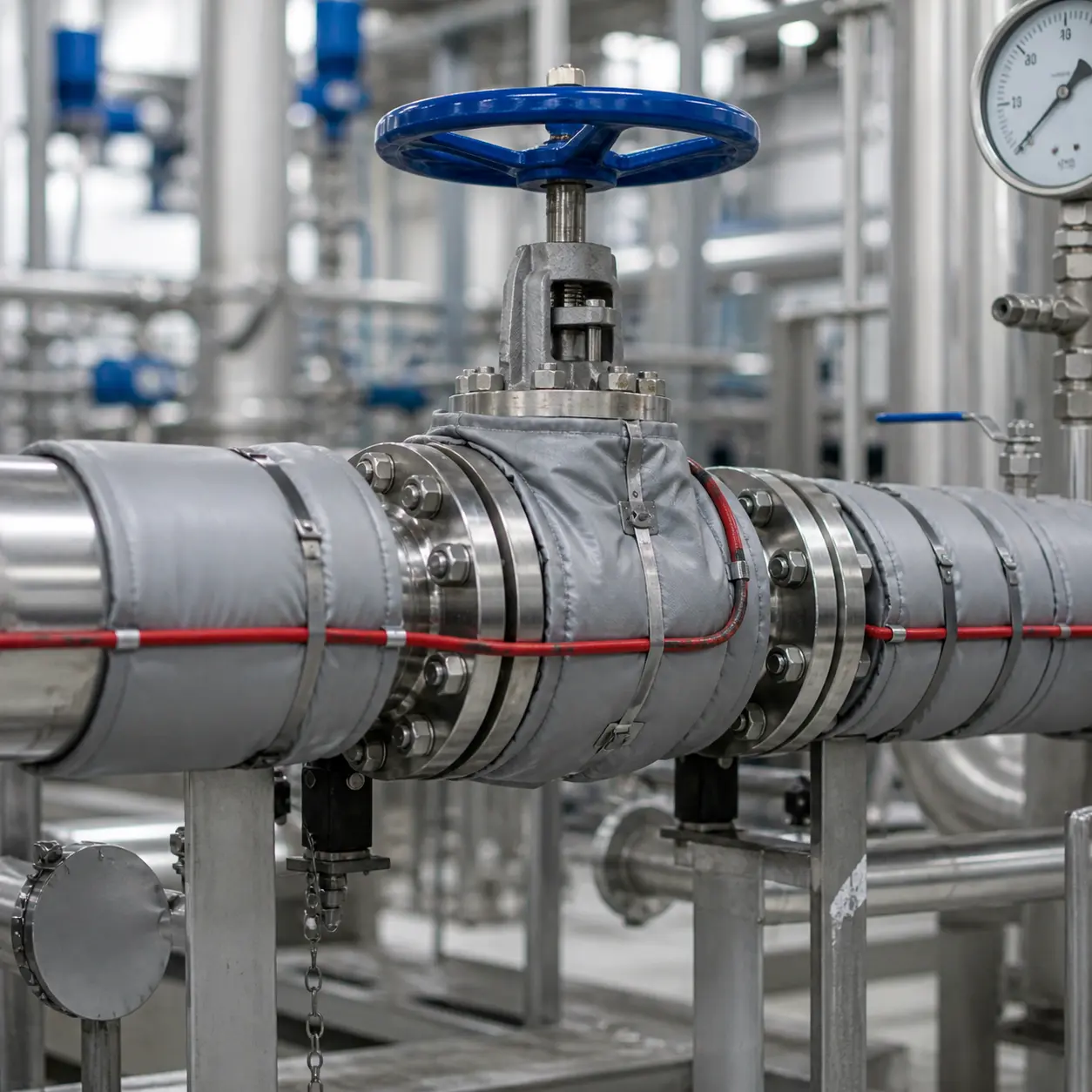
In industrial piping systems, ensuring process continuity depends not only on protecting straight pipeline sections but also on securing critical localized components such as valves and flanges. These elements are inherently more vulnerable to heat loss due to their complex geometry, larger surface areas, and exposure to environmental conditions. For this reason, heat tracing applications must specifically address these points to maintain system integrity and operational reliability.
Valves and flanges function as control, connection, and maintenance points within a system. However, their structural design creates natural weak points where heat dissipation occurs more rapidly than in standard pipe sections. When temperature drops occur at these locations, fluid properties can change significantly, leading to increased viscosity, reduced flow efficiency, or even complete freezing. This makes localized thermal protection not just beneficial but essential.
From a safety and compliance perspective, especially in 2026 where industrial systems are increasingly evaluated based on resilience and audit readiness, these points must be engineered with precision. A failure at a single valve or flange can disrupt entire operations, particularly in critical infrastructure such as chemical processing or fire protection systems.
Understanding what is heat tracing? becomes crucial in this context, as it highlights the importance of maintaining consistent temperatures across all components—not just the main pipeline. Similarly, advanced heat tracing systems are designed to provide targeted heating solutions that address these high-risk areas effectively.
Adatech approaches such challenges with a comprehensive engineering perspective, ensuring that every component is analyzed and protected according to its specific requirements. This holistic methodology strengthens system reliability and supports long-term operational performance .
Valves and flanges are among the most critical heat loss points in industrial piping systems due to their structural complexity and exposure characteristics. Unlike straight pipes, these components introduce irregular geometries and multiple connection interfaces, which significantly increase the surface area exposed to ambient conditions. This results in faster heat dissipation and makes them more susceptible to temperature drops.
Additionally, insulation at these points is often more difficult to implement effectively. Standard insulation solutions may not fully cover the complex shapes of valves and flanges, leading to gaps and thermal bridges. These weak insulation areas allow heat to escape more rapidly, creating localized cold zones. Even if the main pipeline maintains the required temperature, these areas can become starting points for freezing or process instability.
The geometric complexity of valves and flanges significantly affects how heat is distributed across their surfaces. Unlike uniform cylindrical pipes, these components include bolts, joints, cavities, and varying thicknesses, all of which disrupt uniform heat flow.
This irregular structure creates multiple areas where heat can dissipate rapidly, leading to uneven temperature distribution. As a result, certain sections may cool faster than others, increasing the risk of localized freezing.
Valves and flanges are typically constructed from dense metal materials, which directly influence their thermal behavior. While these materials can store heat, they also transfer it quickly to the surrounding environment, especially under cold conditions.
Their higher mass requires more energy to maintain stable temperatures. Without dedicated heat tracing, these components cool faster than adjacent pipes, creating temperature differences within the system.
When heat tracing is not applied to valves and flanges, a range of operational and safety issues can arise. These components, already prone to higher heat loss, quickly become weak points where temperature drops occur first. This leads to inconsistencies within the system and can trigger a cascade of problems affecting overall performance.
Without localized heating, fluid properties begin to change as temperatures fall. Increased viscosity, reduced flow efficiency, and eventual freezing are common outcomes. These issues not only disrupt operations but also increase the risk of equipment damage and safety hazards.
One of the most critical risks is freezing. When temperatures fall below a certain threshold, fluids can solidify within valves and flange connections. This leads to blockages that completely stop the flow.
Freezing also causes expansion, which can damage valve bodies and flange seals. Cracks, leaks, and permanent deformation are common results, all of which require costly repairs and downtime.
Temperature stability is essential for maintaining consistent process conditions. Heat loss at valves and flanges introduces fluctuations that disrupt system balance.
In industries such as chemical processing, even small temperature variations can affect reaction rates and product quality. These localized cold areas make process control more difficult and reduce overall efficiency.
Without proper heat tracing, valves and flanges require frequent maintenance due to recurring issues such as freezing and leakage. This leads to increased labor costs and unplanned shutdowns.
Emergency interventions are often more expensive and disruptive than preventive solutions. Over time, these repeated issues significantly impact operational budgets and system reliability.
Implementing heat tracing on valves and flanges requires a specialized engineering approach that takes into account their higher heat loss rates and complex geometries. Unlike straight pipe sections, these components demand additional heating capacity and more precise design considerations. A successful implementation begins with accurate heat loss calculations, ensuring that the selected heat tracing cable and power output are sufficient to maintain the required temperature under all operating conditions.
In modern industrial applications, especially in 2026 where system reliability and inspection readiness are critical, heat tracing design must be approached as an integrated solution. This includes proper cable routing, insulation compatibility, and environmental considerations. When all these factors are aligned, valves and flanges can maintain stable temperatures, preventing operational disruptions and ensuring long-term performance.
Cable placement for valves and flanges must be carefully designed to address their increased heat loss. Unlike straight pipelines where linear installation is sufficient, these components require more strategic cable routing to ensure full surface coverage.
The heat tracing cable should be wrapped around valve bodies, flange connections, and other exposed surfaces. In many cases, additional loops are necessary to compensate for higher heat dissipation. Special attention should be given to flange joints and lower sections, where heat loss is typically greater. Proper placement ensures uniform heat distribution and eliminates cold spots.
Insulation plays a critical role in the effectiveness of heat tracing systems. For valves and flanges, standard insulation methods are often insufficient due to their irregular shapes. Therefore, custom insulation solutions such as removable jackets are commonly used.
Proper insulation minimizes heat loss, improves energy efficiency, and protects the system from environmental factors such as wind and moisture. It should also allow easy access for maintenance without compromising thermal performance. A well-designed insulation system ensures that the heat generated by the tracing system is retained effectively.
The level of risk associated with valves and flanges varies depending on the type of facility and operating conditions. In environments where temperature control is critical or where systems are exposed to harsh conditions, these components become significantly more vulnerable.
Facilities that handle temperature-sensitive fluids or operate in extreme climates must prioritize heat tracing at these points. This approach ensures system reliability, prevents failures, and supports compliance with modern safety and operational standards.
Outdoor piping systems are directly exposed to environmental conditions such as low temperatures, wind, and moisture. These factors significantly increase heat loss, especially at valves and flange connections.
Wind accelerates convective heat transfer, causing rapid cooling of exposed surfaces. Without proper heat tracing, freezing can occur quickly, even if the main pipeline is insulated. Therefore, outdoor installations require enhanced thermal protection and careful system design.
In process and chemical transfer systems, maintaining precise temperature levels is essential for ensuring product quality and operational efficiency. Valves and flanges in these systems are particularly sensitive to temperature fluctuations.
A drop in temperature at these points can lead to increased viscosity, crystallization, or chemical instability. This can disrupt the process, cause blockages, and lead to production losses. For this reason, these areas require precise and reliable heat tracing solutions.
Fire protection systems, water lines, and auxiliary utilities must remain operational at all times. Any failure at valves or flanges in these systems can lead to serious safety risks.
For example, a frozen valve in a fire protection system can prevent water flow during an emergency. This makes heat tracing not just an operational requirement but a critical safety measure. Proper implementation ensures that these systems remain functional under all conditions.
Proper implementation of heat tracing at valves and flanges has a direct and measurable impact on system reliability. These components, often considered weak points, can become strong and stable elements when correctly engineered.
Maintaining consistent temperature across all points of the system prevents freezing, ensures fluid stability, and supports uninterrupted operation. This is especially important in industries where downtime is costly and safety is critical.
From a mechanical perspective, stable temperatures reduce thermal stress on components. This prevents damage such as cracking, deformation, and seal failure. As a result, equipment lifespan is extended and maintenance requirements are reduced.
Additionally, a well-designed heat tracing system improves energy efficiency by delivering heat only where it is needed. This targeted approach minimizes energy waste and supports sustainable operations.
Adatech’s engineering approach focuses on analyzing each component in detail and providing tailored solutions that enhance overall system performance. This ensures long-term reliability, safety, and operational efficiency.
In industrial safety, minimizing risks is not only about equipment quality but also about understanding the physical and chemical properties...
Devamını Oku
LNG, short for Liquefied Natural Gas, has become an increasingly important energy source thanks to its ease of transportation and...
Devamını Oku
Factory automation systems refer to the integration of technology, software, and machinery to control industrial processes with minimal human intervention....
Devamını Oku